
Introduction
Online business ideas that actually work are those built on real demand, repeat customers, and long-term value creation, not trends, hacks, or short-lived opportunities that fade once attention disappears.
Every year, thousands of new online business ideas appear—and disappear. Beginners often jump from one idea to another, believing the problem is choosing the “wrong” idea. In reality, most failures happen because people choose ideas that cannot last. This article explains which online business ideas actually work in the long run, why they survive when others fail, and how beginners can choose business models that grow stronger with time instead of collapsing after early excitement.
Table of Contents
What Makes an Online Business Work Long Term
Why Most Online Business Ideas Fail
Online Business Ideas That Actually Work
Comparison Table: Short-Term vs Long-Term Ideas
Common Beginner Mistakes and Fixes
Information Gain: Longevity Beats Virality
Real-World Scenario: Trend vs Timeless Business
Tools That Support Long-Term Businesses
FAQs (People Also Ask)
Conclusion
What Makes an Online Business Work Long Term
A long-term online business has three core traits:
Ongoing demand – people need it repeatedly
Scalability – growth without equal effort growth
Adaptability – ability to evolve with markets
Businesses that work long term are rarely exciting at the start. They focus on usefulness, not hype.
From practical observation, businesses built around solving boring but real problems tend to last the longest.
Why Most Online Business Ideas Fail
Most online business ideas fail for predictable reasons:
They rely on trends or loopholes
They have no repeat customers
They require constant promotion to survive
They stop working when platforms change
Failure is usually structural, not motivational.
If an idea stops earning the moment attention stops, it is not built for longevity.
Online Business Ideas That Actually Work
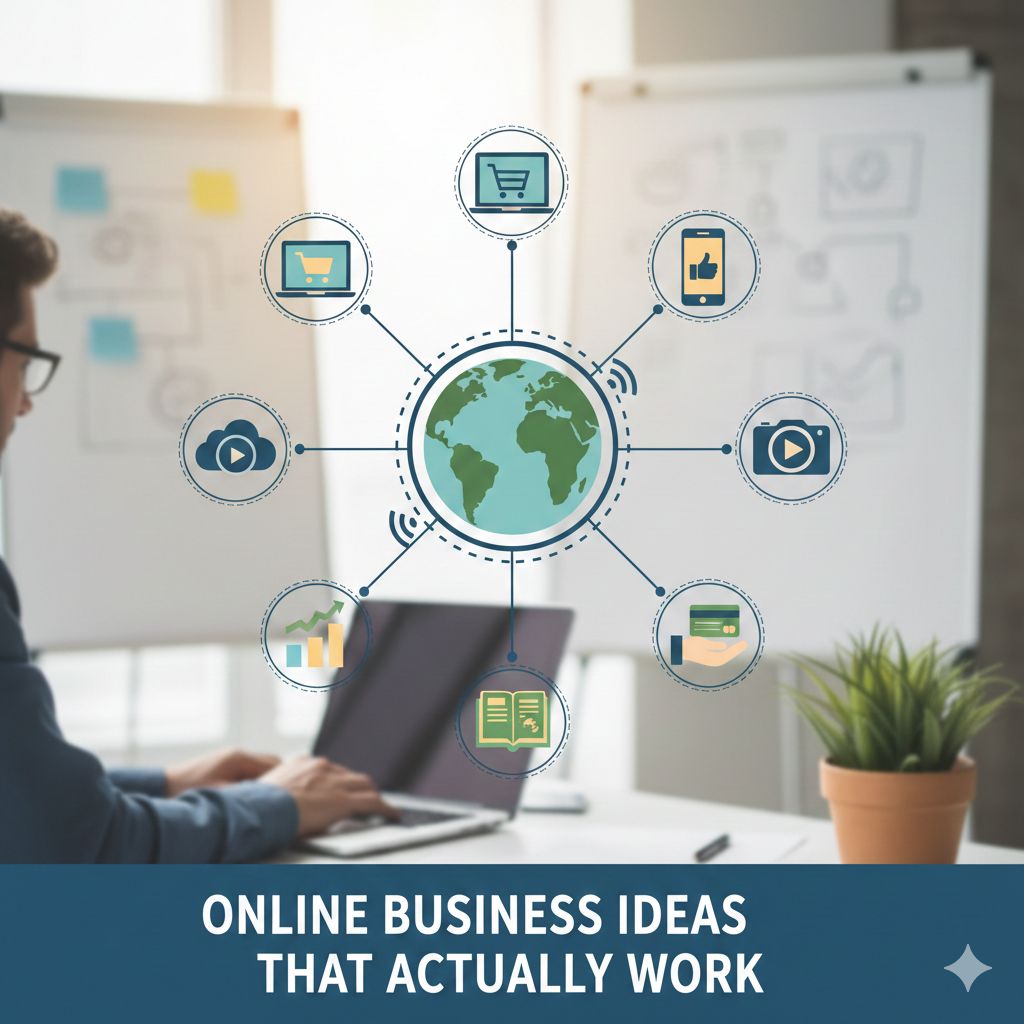
Content-Based Businesses (Evergreen Model)
Content businesses work when they answer long-lasting questions.
Examples:
Niche blogs
Educational websites
Tutorial-based platforms
youtube
https://www.youtube.com/watch?v=U9hZkz8pZKQ
(How evergreen content builds long-term income)
Content compounds as more assets are created.
Service-to-System Businesses
Many strong online businesses start as services and evolve into systems.
Examples:
Freelance services → agencies
Consulting → digital products
Done-for-you services → subscriptions
This model works because demand is proven first.
Digital Products With Repeat Demand
Products that solve ongoing problems last longer than one-time trends.
Examples:
Templates
Courses
Toolkits
Educational memberships
The key is repeat relevance, not novelty.
Audience-Based Businesses
Businesses built on trust and attention can monetize in many ways.
Examples:
Newsletters
Communities
Educational platforms
The asset is relationship, which strengthens over time.
Comparison Table: Short-Term vs Long-Term Ideas
| Factor | Short-Term Ideas | Long-Term Ideas |
| Demand | Temporary | Ongoing |
| Growth | Fast, unstable | Slow, compounding |
| Risk | High | Lower |
| Dependence | Trends/platforms | Value & trust |
| Lifespan | Months | Years |
Common Beginner Mistakes and Fixes
Choosing Ideas Based on Hype
Fix: Choose ideas people will need next year, not just today.
Expecting Fast Success
Fix: Measure progress in months, not days.
Ignoring Repeat Customers
Fix: Build systems that encourage return users.
[Expert Warning]
If an online business idea only works while it’s “new,” it is not sustainable.
Information Gain: Longevity Beats Virality (SERP Gap)
Most articles rank business ideas by popularity. That’s misleading.
Virality brings:
Traffic spikes
Short-term income
High competition
Longevity brings:
Stable growth
Predictable income
Compounding results
From real experience, businesses that grow quietly for years outperform viral successes that burn out. This longevity-first thinking is rarely emphasized in top-ranking content.
Real-World Scenario: Trend vs Timeless Business
Two beginners start online businesses.
One jumps into a trending idea and earns fast—but income disappears.
The other builds a small content platform around a real problem—income grows slowly but steadily.
In practice, timeless value outlasts trendy execution.
[Pro Tip]
Ask yourself: Will people still need this solution in two years?
Tools That Support Long-Term Businesses
Content management systems
Email and audience tools
Analytics dashboards
Customer feedback platforms
Use tools that support consistency and adaptation, not shortcuts.
FAQs
Q1: What online business ideas work best long term?
Content, services, and digital products with repeat demand.
Q2: Are long-term businesses slow to grow?
Yes, but they become more stable over time.
Q3: Can beginners build long-term online businesses?
Yes, with patience and focus on value.
Q4: Why do trend-based businesses fail?
They lose demand once interest fades.
Q5: Do long-term businesses require more effort?
They require patience, not constant hustle.
Q6: Can long-term businesses become high income?
Yes, compounding growth leads to strong results.
Conclusion
Online business ideas that actually work are not secrets—they are systems built for durability. When beginners focus on ongoing demand, repeat value, and adaptability, online businesses grow stronger year after year. Avoid chasing trends, invest in usefulness, and let time amplify your results. Longevity, not excitement, is the true advantage.
Internal Link
Online Business Models Explained: Which One Fits You Best? – earnfuel.com